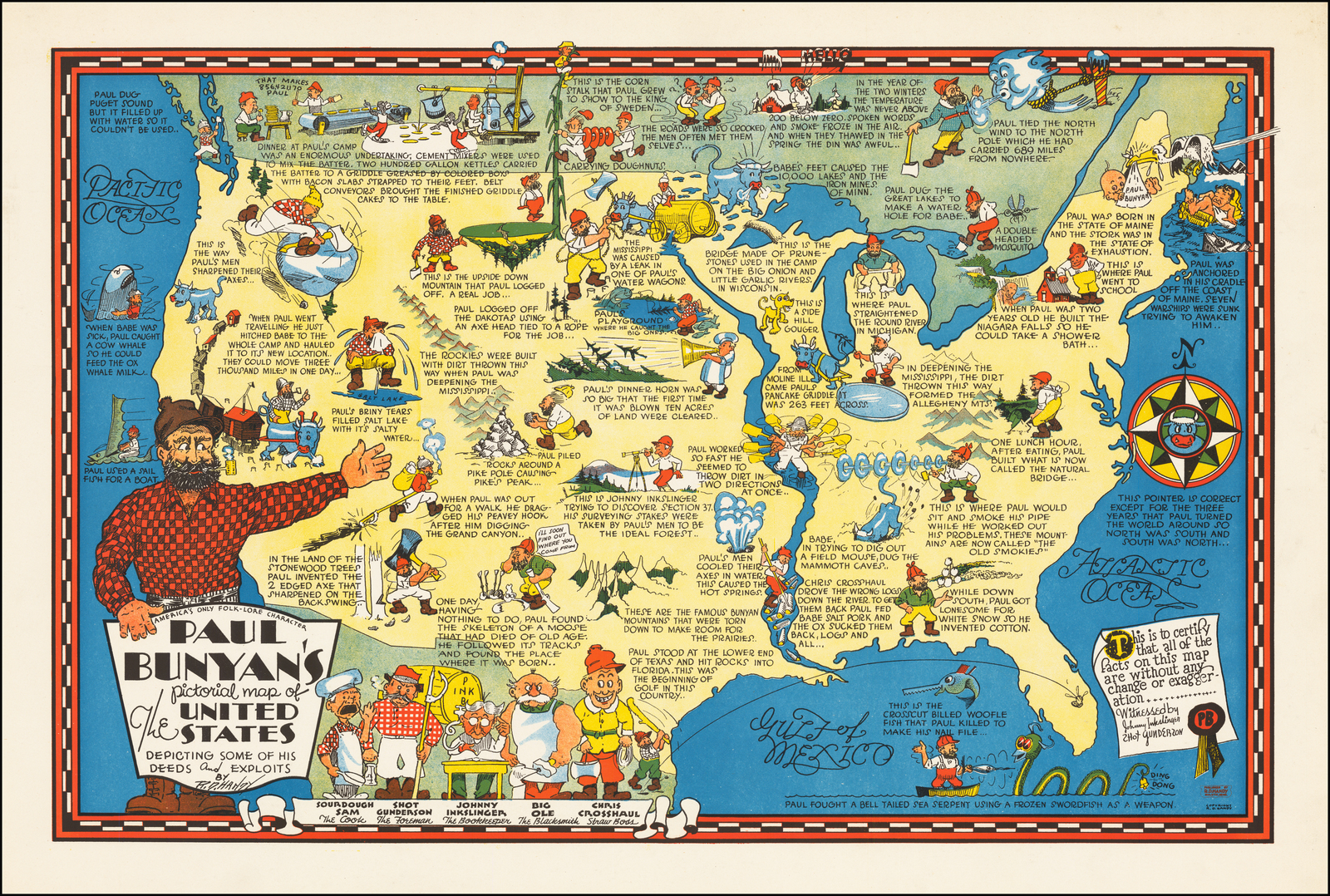
Paul Bunyan
Paul Bunyan is a mythological lumberjack who is usually described as a giant as well as a lumberjack of unusual skill. The character was first documented in the work of U.S. journalist James MacGillivray in 1910. In 1916, as part of an advertising campaign for a logging company, advertisement writer William Laughead reworked the old logging tales into that of a giant lumberjack and gave birth to the modern Paul Bunyan legend, thereby making Paul Bunyan a fakelore character.
https://www.raremaps.com/gallery/detail/64579
Many tales are told of Paul Bunyan the giant woodsman - mightiest hero of the North Woods! A man of great size and strength, he was taller than the trees of the forest. He had such strength in his huge arms that they say he could take the tallest pine tree and break it in two with his bare hands. They tell of his mighty deeds and strange adventures from Maine to California.
He could outrun the swiftest deer and cross the widest river in one great stride! Even today lumber-jacks who work in the woods find small lakes and point them out; saying:
"Those are the footprints of Paul Bunyan that have been filled with water."
A giant logger was Paul, and he chopped down whole forests in a single day. And he and his woods-men logged off North Dakota in a single month! His axe was as wide as a barn door and had a great oak tree for a handle, It took six full-grown men to lift it!
They say that he was born in Maine, and even as a baby he was so large that his mother and father had to have fourteen cows to supply milk for his porridge. Every morning when they looked at him he had grown two feet taller.
They built a huge cradle for Paul and floated it in the ocean off the coast of Maine. The ocean waves would rock him to sleep.
One day he started bouncing up and down in his cradle and started a seventy-foot tidal wave that washed away towns and villages. After that Paul's folks gave up the idea of a floating cradle and took Paul with them into the Maine woods. Here they felt he could be kept out of mischief.
Paul spent his boyhood in the woods and helped his father cut down trees. They sawed the trees into logs and tied them together into large rafts which were floated down the river to the sawmills. Even as a boy he had the strength of twelve men and could ride a raft through the wildest rapids in the river.
One day the man at thc sawmill refused to buy the logs. They were too large for his mill to cut up into lumber. So Paul chained them together again and pulled the raft back up the river to his father's camp. Imagine his dad's surprise to see young Paul wading up the river towing the great raft of logs behind him!
Everybody liked young Paul, and for miles around they told of his great feats of strength: of how he took an iron crowbar and bent it into a safety pin to hold together a lip in his trousers; of how at another time he came to the end of the field he was plowing with two oxen and, having no room to turn the plow and oxen around, he picked up the plow, oxen and all, and turned them around to start back the other way.
Yet Paul never boasted. When people asked him how strong he was he just laughed. And when Paul laughed, the folks in the villages ran into their houses and hid in the cellars, thinking it was a thunderstorm!
In spite of his huge size, Paul was as quick as lightning. They say he was the only man in the woods who could blow out a candle at night and hop into bed before it was dark.
Being so quick on his feet was once his undoing. He was out in the woods hunting one day and shot at a bear. Paul was anxious to see if he had hit, and ran lickety-split toward it, only to get there before the shot he had fired. The result was that he received a full load of his own buckshot in the seat of his breeches.
When Paul was grown he decided he wanted to become the greatest lumberjack in America . and perform great feats of logging. He dreamed of leading his men through wondrous adventures in the great forests of the West.
Paul Bunyan's Camp on Onion River
One day Paul's father was offered a contract to log the Onion River County, which was in the mountains to the west. It was wild and mountainous, and his father refused. Paul spoke up:
"Father, I am no longer a boy. I want to become the world's champion logger. With the help of your men and Babe the Blue Ox, I will log the Onion River County and start a camp of my own."
His father agreed, and Paul gathered a crew of the finest lumberjacks in the land. He promised them many fine adventures if they would follow him into the new country.
They gathered their axes and saws and loaded the wagons. Paul had Ole the Blacksmith put wheels under the kitchen and dining room, and even under the bunkhouses where the men slept at night. Paul tied them together with strong logging chains, and Babe the Blue Ox pulled the camp houses after him as if they had been so many toothpicks.
When they arrived, the first thing Paul set out to do was to build the largest logging camp in the world. People for miles around . came to see it when it was finished. It was so big that when it was breakfast time in the kitchen, it was dinnertime in the blacksmith shop at the other end of the camp.
Every day more men joined the camp of Paul Bunyan. Finally, there were so many that Paul had them work in three shifts: one group working in the woods, one going and coming from the woods, and a third at camp, eating.
Paul bought a great watch so that everybody would know when it was mealtime. It was four feet across the face, and he tied it to his trousers pocket with a logging chain. Of course it cost a lot of money, but Paul said it gained enough time in the first three days to pay for itself.
At dinnertime Hot Biscuit Slim would blow a huge dinner horn. It was so large and made such a noise that he knocked down two hundred trees and started a windstorm on the Gulf of Mexico. After that, they decided not to use it. Later they sold it, and the tin was used to put a new roof on the Capitol at Washington.
It was a very busy camp. Hundreds of men, called swampers, cut paths through the woods. Then the sawyers came and sawed the trees down. As the trees fell, you could hear the men shouting, "Timber! Timber-r-r!" to warn the others. Another crew cut the trees up into logs. Then Babe the Blue Ox pulled them down to the river, where they were left until spring. Then they were floated down the river in great rafts to the waiting sawmills.
Paul Bunyan finally invented the double-bitted axe with a blade on each side so his men could work twice as fast. Paul himself cut down the largest trees. Sometimes he chopped so fast his axe became red-hot and had to be dipped into a lake of cold water every five minutes to cool it off.
Ole the Big Swede proved to be the best blacksmith on Onion River. When he started to shoe a horse, he would take the animal right up into his lap like a baby. Then he would turn the horse on its back and nail the shoes on. He never took more than ten minutes to shoe a horse.
He once made a set of great iron shoes for Babe the Blue Ox. They were the largest shoes in the world. They were so heavy that when Ole carried one of them from the blacksmith shop he sank two feet in solid rock at every step!
Day by day the camp covered more ground until the men had to take a week's food with them when they walked from one end of it to the other. Even the smokestack on the kitchen was so high they had to have it hinged in the middle to let the clouds go by. The dining-room tables were two miles long, and the cookhouse boys wore roller skates so they could serve the food quickly.
Everything was on a huge scale. Even the crumbs that fell on the floor were so large that the chipmunks who ate them grew as large as wolves. They chased all the bears out of the country. Later the settlers who came shot them for tigers! Every morning after breakfast it took a crew of thirty men to dispose of the eggshells, coffee grounds, and prune pits that were piled outside the cookhouse window.
Finally, all the logs were cut and floated down the Onion River to the mills, and Paul decided to move on into a new country which lay directly to the west. The new country was later known as the Red River Valley.
Hot Biscuit Slim and Cream Puff Fatty
The Red River got its name from Paul's camp. It seems one of Paul's cookhouse boys drove a ketchup wagon in the dining room. Every meal the men ate so much ketchup that the boy would get only halfway around when his wagon would be empty.
This made him so, angry that one day he tipped the ketchup wagon over and left camp. The ketchup ran down into the river and colored the water red, and to this day that part of the country is known as the Red River Valley.
When Paul moved his camp into the new country he found that the dining room was still too small for al1 his men. Every day dinner would be from two to three hours late. Paul became angry and shouted "Hot Biscuit Slim!" Three men who were standing beside him were blown over by the force of his voice. They rolled over and over and lit on their feet running and never stopped until they were well out of the reach of his voice.
Hot Biscuit Slim, the cook, came on the run. Paul said, "I want a larger kitchen where two hundred cooks can work at the same time. Also build a larger dining room. Make the tables six miles long! Yesterday the men sat down to dinner and it was lunchtime the next day before the food arrived. By that time the biscuits were cold, and who wants cold biscuits?"
So they cleared the forests for miles around and built a huge kitchen and dining room. The blacksmith, Ole the Swede, made a huge black kettle. It held eleven hundred gallons of soup.
When Hot Biscuit Slim made soup he rowed out into the center of the kettle with boatloads of cabbages, turnips, and potatoes, and shoveled them into the boiling-hot water. In a few hours they had wonderful vegetable soup.
Next the blacksmith made a ten-acre griddle pan for hot cakes. Hot Biscuit Slim strapped flat sides of bacon on the feet of the cookhouse boys. They skated back and forth over the huge griddle until it was well greased.
They thought it was great fun and played tag and crack the whip. The griddle was hot, and they sometimes fell and burned their trousers. When the griddle began to steam, it became so foggy no one could see across it.
Every Sunday morning for breakfast Paul's campers had hot griddle cakes. They were so large it took five men to eat one. Paul himself ate twelve or fourteen. The cookhouse boys worked all day Saturday mixing dough and bringing in huge barrels of maple syrup.
Sunday dinner, however, was the biggest meal of the week. Hot Biscuit Slim would cook the very best soup, the finest vegetables, and the nicest spring chickens.
One Saturday he said to Ole the Big Swede, "Tomorrow, I am going to have the best Sunday dinner of the year. When the men are through eating my hot biscuits with jelly, spinach, cucumbers, young red radishes, and chicken pie, they won't be able to eat a mouthful of dessert."
Cream Puff Fatty, who made the desserts, overheard this. He was very angry, for his pride was hurt. “So Hot Biscuit Slim thinks. they won't eat any dessert. We shall see!" said he.
Cream Puff Fatty called the dessert boys together and said. "We will make cream puffs that will melt .in your mouth! Light creamy ones with whipped cream a foot high! We shall see if they refuse to eat dessert!"
The dinner hour arrived. The men sat down and started to eat. Soup, vegetables, and salads disappeared as the men ate and ate. When the chicken pie arrived, they were almost full.
"Oh look! Chicken pie!" they shouted. They ate the chicken pie. Then the cookhouse boys on roller skates brought in more large platters of food.
"Hot biscuits and jelly! Hurrah!" they cried. They ate the biscuits and there didn't seem to be room for another mouthful of food. Cream Puff Fatty was in despair. He looked down the long dining room. The men were almost finished. It looked as if they couldn't eat another mouthful.
"Now is the time, boys!" cried Cream Puff Fatty. The dessert boys strapped on their roller skates and started down the long tables.
"Cream puffs! Cream puffs!" the men shouted as they saw large plates of fluffy white cakes topped with whipped cream. With a shout they picked up their forks and started eating again. Not a man left the dining room! Every single cream puff was eaten!
"Three cheers for Cream Puff Fatty!" yelled the men. The fat little dessert cook had tears of joy in his eyes, "It was a wonderful dinner!" said Cream Puff Fatty as he shook hands with Hot Biscuit Slim.
The Mysterious Round River
When Paul Bunyan had cut down all the trees in the Red River Country, he called his men together.
“Tomorrow we go into the North Woods where no white man has ever gone before. It is to the west and north near the Great Lakes. And it is the largest forest in the world. The Indians say that the trees grow so large it takes all afternoon to walk around one."
Tiny Tim, the water boy, was so excited he clapped his hands.
Paul Bunyan Digs the St. Lawrence River
One summer Paul decided to leave the North Woods and go back to Maine to visit his father and mother. When he arrived, they talked about old times, and Paul asked about Billy Pilgrim, the biggest man in that part of the country.
"What is this Billy Pilgrim doing?" asked Paul.
"He is digging the St. Lawrence River between the United States and Canada," said Paul's father. "There was nothing to separate the two countries. People never knew when they were in the United States and when they were in Canada."
Paul Bunyan went to see Billy. He found that Billy Pilgrim and his men had been digging for three years and had dug only a very small ditch. Paul laughed when he saw it.
"My men could dig the St. Lawrence River in three weeks," said Paul.
This made Billy angry for he thought no one could dig a large river in three weeks.
"I will give you a million dollars if you can dig the St. Lawrence River in three weeks!" said Billy Pilgrim.
So Paul sent for Babe the Blue Ox, Ole the Big Swede, Brimstone Bill, and all his woodsmen.
Paul told Ole to make a huge scoop shovel as large as a house. They fastened it to Babe with a long buckskin rope. He hauled many tons of dirt every day and emptied the scoop shovel in Vermont. You can see the large piles of dirt there to this day. They are. called the Green Mountains.
Every night Johnnie Inkslinger, who did the arithmetic, would take his large pencil and mark one day off on the wall calendar.
Billy Pilgrim was afraid they would finish digging the river on time. He did not want to pay Paul Bunyan the million dollars, for at heart he was a miser. So he thought of a plan to prevent Paul from finishing the work.
One night Billy called his men together and said, "When everybody has gone to bed we will go out and pour water on the buckskin rope so it will stretch, and Babe the Blue Ox will not be able to pull a single shovelful of dirt!"
The next day, Babe started toward Vermont with the first load of dirt. When he arrived there, he looked around, and the huge scoop shovel was nowhere to be seen. For miles and miles the buckskin rope had stretched through the forests and over the hills.
Babe didn't know what to do. He sat down and tried to think, but everyone knows an ox isn't very bright; so he just sat there. After a while the sun came out and dried the buckskin and it started to shrink to normal size.
Babe planted his large hoofs between two mountains and waited. The buckskin rope kept shrinking and shrinking. Soon the scoop shovel came into view over the hills. Then Babe emptied it and started back after another load.
In exactly three weeks the St. Lawrence River was all finished, but still Billy Pilgrim did not want to pay Paul the money.
"Very well," said Paul, "I will remove the water!" So he led Babe the Blue Ox down to the river, and Babe drank the St. Lawrence River dry.
Billy Pilgrim only chuckled to himself, for he knew that the first rain would fill it again. Soon it began to rain, and the river became as large as ever.
So Paul picked up a large shovel.
"If you do not pay the money you owe me I will fill the river up again, said Paul.
He threw in a shovelful of dirt. He threw in another and another, but still Billy Pilgrim would not pay him the money.
"I will pay you half your money," said Billy. Paul again picked up his shovel and tossed more dirt into the river.
"I will pay you two thirds of your money,” said Billy.
Paul kept throwing more dirt into the river until he had thrown a thousand shovelfuls.
"Stop! I will pay you all your money!" cried Billy.
So Paul Bunyan was finally paid in full for digging the St. Lawrence River. The thousand shovelfuls of dirt are still there.
They are called the Thousand Islands.
The Kingdom of North Dakota
Soon after Paul had finished digging the St. Lawrence River, he received a letter from . the King of Sweden. It seems that the King had heard of Paul Bunyan through Ole the Big Swede. He wanted Paul to cut down all the trees in North Dakota so the Swedes could settle there and farm the land. The King wrote that he wanted this job done in one month so the farmers could plant their grain at once. All the trees were to be cut up and made into toothpicks for the Swedish army.
When this huge job was finished, all the Swedes in North America were to settle in the New Kingdom of North Dakota and farm the land. This was about the largest job that Paul ever attempted. He soon gathered his men together and started moving his camp to North Dakota. When they all arrived, he built the largest camp the world had ever seen.
The bunks in the new sleeping quarters were eighteen decks high, and the men in the top bunks had to get up an hour earlier in the morning in order to get down to breakfast on time. The dining room was longer than ever, and the boy that drove the salt and pepper wagon around the tables would only be halfway around by nightfall. He would stay overnight at the other end and drive back the next day.
Paul had to finish the job in one month, so he hired the Seven Axemen. They were famous woodsmen and could cut down .trees faster thah anyone except Paul hirnself. They were all cousins, and each was named Frank. It was very confusing, because every time Paul shouted "Frank!" all the Seven Axemen would drop their work and run over to see what he wanted.
The Seven Axemen used great double-bitted axes that an ordinary man could not lift. When their axes became dull they would start a round, flat rock rolling down the hillside and run beside it holding the blades of their axes against the rock until they were sharp again.
No matter how fast they worked, the huge job was always being delayed. Paul began to have bad luck. First, Babe the Blue Ox lost his heavy iron shoes in a swamp, and a new mine had to be opened to get enough iron to make him a new set.
Next came the great fog that covered the earth like a blanket. It was so thick that the fish in the river couldn't tell where the water left off and the fog began. They swam around in the fog and got lost among the trees in the forest. When the fog disappeared, thousands of small fish were left in the woods many miles from the nearest stream.
The Seven Axemen had to chop a tunnel in the fog from the kitchen to the dining room so the cooks could serve food. The fog even got into the coffee and made it so weak the men wouldn't drink it. At night the men had to sleep with mosquito netting over their heads to keep the tadpoles from getting in their ears.
Finally the fog went away, but all the blankets and shirts were so wet it took fourteen days to dry them out.
At last all the trees were cut down and split into toothpicks, but still the King of Sweden wasn't satisfied. He wrote Paul another letter which said, "My farmers will not be able to till the soil with all the stumps," and the farmers refused to settle in the new Kingdom of North Dakota.
Paul called Johnnie Inkslinger into the office and said, "You are good at solving problems. What are we going to do about the stumps?" Johnnie Inkslinger thought and thought for seven days and nights.
"We will send for several large fire hoses and food the ground with water!" said Johnnie Inkslinger finally. "Babe the Blue Ox, as you all know, doesn't like to get his feet wet for that gives him a cold in the head.
"With water all over the ground, he will walk on the stumps. He is so heavy his huge hoofs will drive the stumps into the ground.”
The men did as Johnnie said. They covered the whole country with water, Babe roamed all over North Dakota, stepping very carefully from stump to stump to avoid getting his feet wet. His heavy weight drove the stumps six feet under the ground.
The King of Sweden was finally satisfied, and to this day there isn't a single tree or stump in the whole state of North Dakota.
The Popcorn Blizzard
When Paul Bunyan had cut down al1 the trees in North Dakota, he decided to go west. It was summertime, and the forest was sweet with the smell of green trees. The spreading branches cast their cool shadows on the ground.
"We must cross vast plains,” said Paul to his men, “where it is so hot that not even a blade of grass can grow. You must not become too thirsty, as there will be very little water to drink.”
Paul knew it would be a long, hard journey, so he decided to send all the heavy camp equipment by boat down the Mississippi River and around the Horn to the Pacific Ocean. Paul told Billy Whiskers, a little bald-headed logger with a bushy beard, to take a crew of men and build a boat. Billy had once been a sailor. In a short time the boat was finished and loaded with all the heavy camp tools.
Everyone cheered as Billy Whiskers and his men started down the Mississippi River on their long trip. Billy wore an admiral's hat and looked every inch the sailor, although he hadn't been on board a ship for thirty-five years.
With Paul and Babe the Blue Ox leading the way, the rest of the camp then started across the plains on their long journey west. In a few days they had left the woods and were knee-deep in sand that stretched out before them for miles and miles. The sun became hotter and hotter!
“I made some vanilla ice cream," said Hot Biscuit Slim one day as he gave the men their lunch, “But the ice became so hot , under this boiling sun that I couldn't touch it!"
Tiny Tim, the water boy, was so hot and tired that Paul had to put him up on Babe's back, where he rode the rest of the trip. Every time Babe took a step forward, he moved ahead two miles, and Tiny Tim had to hold on with all his might. Even Ole the Big Swede, who was so strong he could carry a full-grown horse under each arm, began to tire.
There was not a tree in sight. Paul Bunyan's men had never before been away from the forest. They missed the cool shade of the trees. Whenever Paul stopped to rest, thirty or forty men would stand in his shadow to escape the boiling sun.
"I won't be able to last another day," cried Brimstone Bill, "if it doesn't begin to cool off soon!" Even Paul Bunyan became tired finally and took his heavy double-bitted axe from his shoulder and dragged it behind him as he walked. The huge axe cut a ragged ditch through the sand that can be seen to this day. It is now called the Grand Canyon, and the Colorado River runs through it.
It became so hot that the men were exhausted and refused to go another step. Hot Biscuit Slim had complained that there was very little food left in camp. That night Paul took Babe the Blue Ox and went on alone into the mountains to the north. In the mountains Paul found a farmer with a barnful of com.
"I will buy your corn," said Paul to the farmer. So he loaded all the corn on Babe's back and started for camp. By the time he arrived there, the sun was shining again and the day grew hotter as the sun rose overhead. Soon it became so hot that the corn started popping. It shot up into the air in vast clouds of white puffy popcorn.
It kept popping and popping and soon the air was filled with wonderful white popcorn. It came down all over the camp and almost covered the kitchen. The ground became white with popcorn as far as the eye could see. It fell like a snowstorm until everything was covered two feet deep with fluffy popcorn,
"A snowstorm! A snowstorm!" cried the men as they saw it falling. Never had they seen anything like it before. Some ran into the bunkhouses and put on their mittens and others put on heavy overcoats and woolen caps. They clapped each other on the back and laughed and shouted for joy.
"Let's make snowshoes!" cried Ole the Big Swede. So the all made snowshoes and waded around in the white popcorn and threw popcorn snow each other, and everybody forgot how hot it had been the day before. Even the horses thought it was real snow, and some of them almost froze to death before the men could put woolen blankets on them and lead them to shelter.
Babe the Blue Ox knew it was only popcorn and winked at Paul.
Paul Bunyan chuckled to himself at the popcorn blizzard and decided to start west again while the men were feeling so happy. He found them all huddled around the kitchen fire.
"Now is the time to move on west," said Paul, "before it begins to get hot again." So they packed up and started. The men waded through the popcorn and blew on their hands to keep them warm. Some claimed their feet were frostbitten, and others rubbed their ears to keep them from freezing.
After traveling for a few weeks more, they saw ahead of them the great forest they had set out to reach. They cheered Paul Bunyan who had led them safely over the hot desert plains. Babe the Blue Ox laughed and winked at Paul whenever anyone mentioned the great blizzard.
After reaching the great forest in the Rocky Mountains, Paul sent Brimstone Bill and Babe on to the Pacific Coast to meet Billy Whiskers and help unload the boat. They finally found the ship outside the entrance to the Golden Gate.
“What's the matter?" shouted Brimstone Bill, "'Why don't you come in to shore?"
"I can't!" cried Billy Whiskers through a large megaphone. "My ship is stuck fast to the bottom of the ocean."
That seemed very queer to Brimstone Bill, for the water was almost a mile deep out in the ocean beyond the Golden Gate. Billy Whiskers rowed ashore and explained. It seems they had made a mistake when they built the ship. The men used new, green lumber that quickly became water-soaked, and the boat started sinking. As soon as the water came up to the edge of the deck, Billy Whiskers would put in to shore and build another deck on top of the first deck.
When that became water-soaked he would build still another deck on top of that. When he finally arrived at the Golden Gate, he found he had one hundred and thirty-seven decks on his ship. And all but one of them was under the water!
Of course, with a boat like that they couldn't go through the Golden Gate, and all the cargo had to be put on rafts and floated ashore. There they loaded everything on the big Blue Ox and were soon back in Paul Bunyan's camp in the Rocky Mountains.