Household Chemicals Workshop
住化では住商と組んでアジアの需要家を招待してピレスロイドのシンポジウムを開いた。
第1回 1978/1/26-27
Bangkok The Dusit Thani Hotel 東南アジア需要家対象
第2回 1978/11/2-3 台北
国賓大飯店楼外楼
筆者は双方に参加し、HOUSEHOLD
INSECTICIDES IN JAPANと題して講演した。
それぞれのWorkshopでの講演項目は以下のとおり。
Bangkokでの Workshop
1. History of Sumitomo's Activity in Pesticides Field :Takeshi
Hoshino
2. Household Insecticides in Japan :Kazuo Nakayama
3. Synthetic Pyrethroids for Mosquito Coil & Aerosol :Shigenori
Tsuda
(A) Quality Control in Mosquito Coil Formulation
(B) Neo-Pynamin for use in Aerosol
台北での Workshop
1. Household and Public Health Insecticides
-- Centering around Pyrethroids :T. Hoshino
2. Safety Aspects of Pyrethroid :Dr. J. Miyamoto
3. Regulation on Sanitary Insecticides :Dr. M. Ueda
4. Insecticide use in Sanitary Insect Control :H. Oouchi,
Dr. M. Ueda
5. Household Insecticides in Japan :K. Nakayama
以下は第1回でのスピーチ(内容は第2回も同じ)
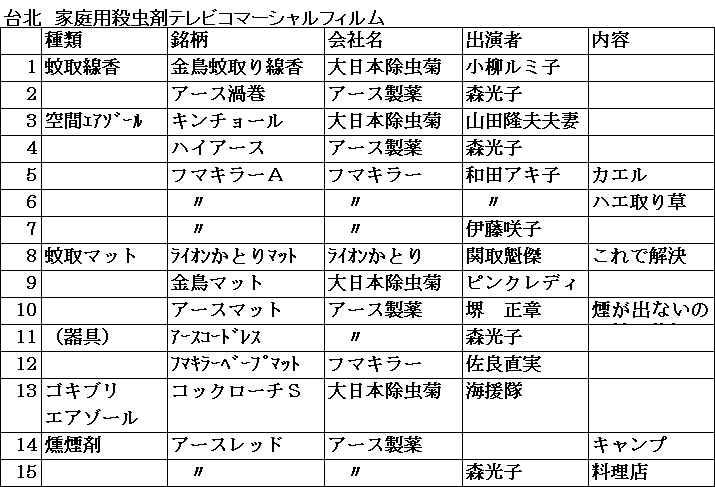
なお、日本の家庭用殺虫剤メーカーのTVコマーシャルを編集し、映写した。
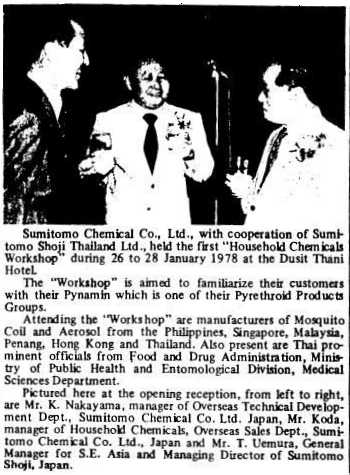
タイの英字紙の記事
写真は中山、幸田(当時農薬輸出)、植村(住商)
HOUSEHOLD INSECTICIDES IN JAPAN
Kazuo Nakayama
1. Situation of household insecticides in Japan
(1) Market size
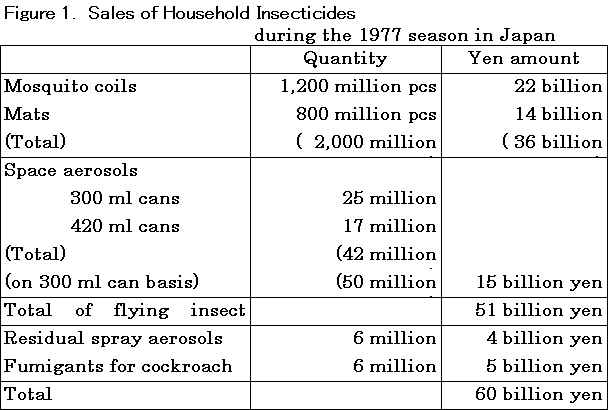
Figure 1 shows the total sales of household insecticides in Japan in the 1977 season ending Oct. 31, 1977. Total sales have reached 60 billion yen (about 250 million US Dollars) on consumers' level. The sales of flying insect killers have more than 80% share of the totals. Main targets are mosquitoes. Nowadays houseflies decrease in number especially in urban areas where houseflies are no longer main targets of pest control. Two types of products are sold; one is a so called fumigant which consists of mosquito coils and electric fumigator mats, and another is a space aerosol.
In the 1977 season 1.2 billion pieces (or 600 million pairs) of coils, 800 million pieces of mats and 50 million cans of space aerosols (on 300 ml can basis) were sold.
Today the population of Japan is 114 million, the consumption of flying insect killers per capita being 17 coils or mats plus 0.4 can of space aerosol in a year. (Or 63 pieces of coils or mats plus 1.3 cans of space aerosol per family. )
Please pay attention to the following fact that mosquitoes become weak and inactive at the temperature under 25℃. Therefore, in Japan, flying insect killers are used only for 60-70 days from June to August. During this short period many insecticides are used.
*1 On consumers'level
*2 Residual spray aerosols do not include those for horticultural use.
*3 1 US Dollar is equivalent to about 240 yen.
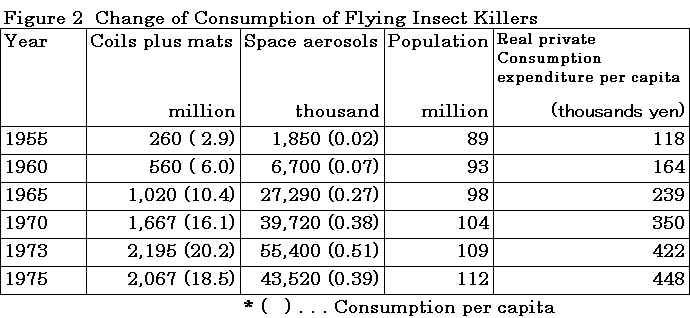
Figure 2 shows the change of consumption in quantity. Within 10 years from 1965 to 1975 the consumption of coils plus mats increased by 100%, while the consumption of space aerosols in 1973 was twice as much as that in 1965.
During this period mosquitoes and houseflies decreased to a great extent. Sanitary conditions have been improved significantly, especially in urban areas where the majority of the population exist. In urban areas flush toilets have been dominant, which has contributed to the decrease of houseflies. Furthermore, the decrease of open ditches due to the extension of modern drainage system and the consumption of pesticides in rice fields have brought the decrease of mosquitoes. In addition to the foregoing, the improvement of housing conditions such as high-storied apartments, aluminum sash windows and air-conditioning facilities has made insect access much more difficult. Today we can not find mosquito nets being sold at stores, which were once indispensable at night.
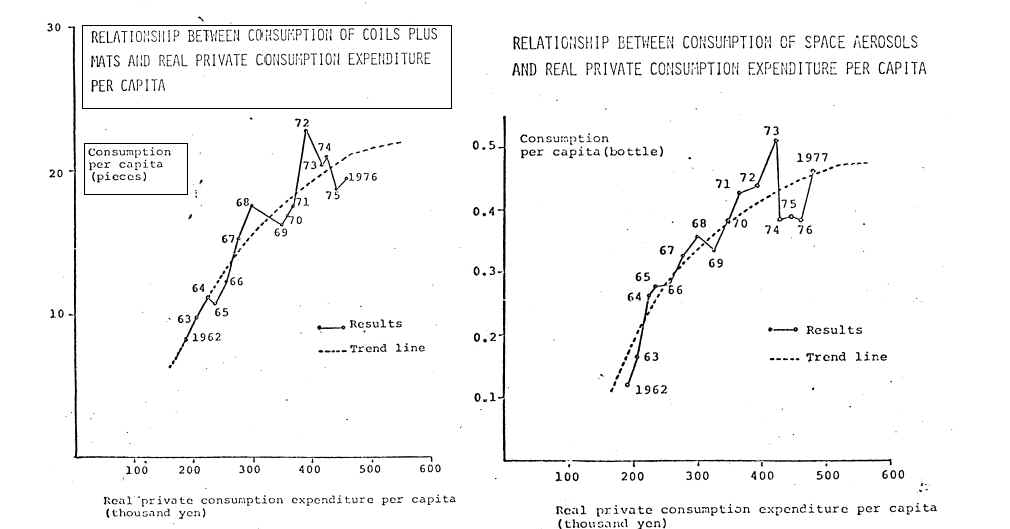
Figure 2 also shows interesting relationship between the consumption of insecticides and real private consumption expenditure per capita. As you see, the consumption of fumigants and aerosols has increased in proportion to the increase of real private consumption expenditure per capita. Pictures 1 and 2 show graphically these relationships. While the target insects have been decreasing for the past years, the consumption of household insecticides has been increasing year by year just as disposable income has increased.
This fact shows that pest control is limitless. Now, in Japan people use insecticides when they find only one mosquito or even when there are no mosquitoes lest they should enter into rooms.
Picture 1 Picture 2
Both TV commercials and the expansion of supermarkets have been helping in increasing the consumption of insecticides. They motivate consumers to buy more and more products.
It is said that TV itself is also contributive. Now people sit up late at night watching TV, which necessitates more use of insecticides.
In such a way, the higher the level of living becomes, the more insecticides are used.
I would like to stress here that household insecticides now sold in Japan contain synthetic pyrethroids as active ingredients and that the safety of them has already proven to Japanese customers who are very sensitive on the toxicity of insecticides.
As to the other insects, I refer to cockroaches also as one of the main targets. Most of the residual aerosols are used for the control of cockroaches. In addition to insecticides, bait boxes are used for that purpose, the annual sales of which are about 10 billion yen.
(2) Recent changes in demand structure
Recently there are some changes in demand structure. The first is the stagnant tendency seen in the increasing rate of consumption of flying insect killers as a whole. After the oil crisis in 1973, the consumers' behavior has changed. Before the crisis, customers were inclined to buy more goods than they needed at the time they could buy cheap, but nowadays they buy only at need. Taking into account the present big consumption of flying insect killers per capita and the short period during which they are used, I see very little possibility for the flying insect killers to show more increasing rate. Though there will be some increase in the future, it will be more moderate than before.
The second trend can be seen in the demand of coils and mats. Among the fumigants for flying insects, mats are replacing coils with tremendous speed. In 1975, 1.7 billion coils and 400 million mats were sold (the ratio of mats was less than 20% of the total). But, in 1977 coils decreased to 1.2 billion pieces and mats doubled to reach 800 million pieces, sharing 40%.
The third trend is the appearance of a new target, cockroach. Though flying insects are in a decreasing tendency, cockroaches have been increasing for the past years. Due to the heating facilities in winter cockroaches have become all-year-pests. The diffusion of sanitary education makes the existence of cockroaches around us unbearable. The appearance of cockroaches in restaurants and dining cars of super-express train of the National Railways is often topics raised in newspapers. It is the big problem that, while the other pests are decreasing, cockroaches are increasing.
Now many formulators who are perplexed at the stagnation of flying insect killers and meet with keen competition as a result study to enter into this field. With the advent of Sumitomo's new pyrethroid, EksminR (NRDC 143), this market seems to grow drastically.
(3) Regulatory aspects
Regulatory system has given a great influence on the development of this business in Japan.
Household insecticides are under the control of the Ministry of Health & Welfare as a kind of medicines, which means that deep concern is put on safety of consumers.
In putting new formulations onto market, the registration is needed, and in order to get registration many kinds of severe tests must be done. In applying for registration the following data are required:Efficacy data
Acute toxicity data
Inhalation toxicity data
Skin and eye irritation data
Stability data, etc.It costs 20 to 30 million yen to prepare the data mentioned above and it takes long time to get new registration.
In order to assure safety of new insecticides, those data are examined deliberately by the Council of Pharmaceutical Affairs which consists of specialists such as university professors.
After registration, many regulations are provided in the way of production and sale of household insecticides.
With regards to marketing an important regulation is that at least one qualified pharmaceutist must be posted at a shop where medicines are sold. Therefore, generally speaking, medicines including household insecticides can be sold only at drug stores.
However, as an exception to this regulation there is a classification called "quasi-medicines". Some medicines, the effect of which is mild and moderate to a human body, can be classified as quasi-medicines and permitted to be sold at shops without qualified pharmaceutists, such as general stores and supermarkets on which the Ministry of Health & Welfare does not keep tabs. Tooth paste, anti body smell agent and repellent are those classified as quasi-medicines. Among the insecticides those which contain only natural or synthetic pyrethroids as active ingredients (excluding some kinds of formulations) are admitted as quasi-medicines. Even aerosols containing Sumithion, very low-toxic organophosphorous insecticide, are not classified as quasi-medicines, which means that the very severe Ministry of Health & Welfare regards synthetic pyrethroids as the safest insecticides.
In case insecticides can be sold at general stores and supermarkets, much more sales can be expected. So most of household insecticides in Japan have been changed to synthetic pyrethroids.
(4) Formulator
Japan Insecticide Industrial Association has 27 members, 23 of which are formulators and 4 are distributors.
We can divide them into three groups.
The first group is those which specialize in household insecticides, and most of the formulators belong to this group. The examples are Dainihon Jochugiku Co., which is the top maker and famous for "Kincho" brands, Fumakilla Ltd., famous for "Vape Mat", Earth Chemical Co., and King Chemicals Co.
The second group consists of pharmaceutical companies. They sell household insecticides through their own drugstore chains. Taisho Pharmaceutical Co., Sankyo Co. and Chugai Pharmaceutical Co. belong to this group.
The last group consists of general household product manufacturers. Kao Soap Co. is the largest soap maker in Japan and with its own special sales channel it has been diversifying its business into many fields, one of which is this field. In a short period Kao Soap has become one of the top aerosol makers. Kao' s competitor, Lion Fat and Oil Co. and its sister company Lion Dentifrice Co. which is the parent company of Lion Insecticide Co. have established a joint sales company dealing with their all domestic sales. As the sales sizes of Kao and Lion are nearly ten times as much as those of top household insecticide companies, their activities are being watched with keen attention.
The increasing dependence on supermarkets has caused changes in market shares. Today total sales by supermarkets have reached about 35% of the total retail sales. There are supermarkets even in rural areas. So the growth of household insecticides is largely attributable to the sales through supermarkets. Under the severe competition among themselves, supermarkets want to sell products which are known to customers through TV commercials. As a result the market share has converged to several top formulators which can spend more amount on advertisements.
Other formulators are now trying to seek markets in such a way that they have subcontract of private brands of some supermarket chains or enter into the business of joint purchase by consumers and labour unions.
(5) Marketing
Usually sales of household insecticides are made through wholesalers and retailers. Wholesalers sell to retailers at about 70 - 80% of list price and wholesalers are given commission of 10 - 15% of their sales price. In addition rebates are paid to wholesalers in proportion to their sales volume.
Household insecticides are seasonal products and sales fluctuate depending upon weather. When autumn comes earlier or it rains much in summer, many products remain unsold. So returning of unsold goods is a custom of this business.
Because of the similarity of efficacy of products, advertisement is a key factor in sales competition among big formulators. They spend large amount of money, 10 - 15% of their sales revenues. Most of the advertisement expenses are used on TV commercials using famous star singers and actresses. (We are going to show you some of the TV commercials later) Dainihon (Kincho) once surprised people by using Miss Hibari Misora, the queen of the singers in Japan, in its commercial film of mosquito coils, because at that time no one thought she would appear on CM films. TV commercials produced many hit products and also popular phrases on everybody's lip in this field.
II. Details of each
product
(1) Mosquito coils
Mosquito coils have a long history in Japan. Around 1890 the seeds of pyrethrum flowers were introduced to Japan and since then pyrethrum flowers were grown in the neighborhood of Seto Inland Sea and Hokkaido. In 1938 the harvest of pyrethrum flowers in Japan reached a record of 13,000 tons, nearly as much as Kenya produces now. Most of them were exported to the USA. In Japan mosquito coils were produced using pyrethrum powders at that time. But, when World War II began, the fields of pyrethrum flowers were converted to those of edible crops and harvest decreased largely. When Kenya began to grow pyrethrum flowers after the war, Japan turned to the importing country.
It was around 1955 when the production of mosquito coils began to increase tremendously. Two inventions brought this increase. One was the invention of automatic coil making machines with which productivity increased surprisingly in comparison with the former hand making way. The other was the invention of Pynamin , the first synthetic pyrethroid by Sumitomo Chemical. The harvest of pyrethrum flowers fluctuates very much depending upon weather and the price upon harvest. Pynamin changed this situation in such a manner to guarantee sufficient and stable supply and stable price.
Recognizing superiority of Pynamin, coil makers began to change raw materials to Pynamin one after another and soon almost all changed to Pynamin.
From the 1978 season which started in November,1977 Japanese coil makers have changed Pynamin to Pynamin-Forte. With the completion of the new plant in Misawa, northern part of Honshu, Sumitomo Chemical has decided to supply Pynamin-Forte instead of Pynamin.
Taking advantage of this opportunity, they increased allethrin contents. In case of Pynamin containing coils makers produced coils of different contents ranging from 0. 3% to 0.6%. This time the content of Pynamin-Forte is standardized at 0.3% (a.i.), equivalent to 0.66% of Pynamin technical grade. Concern on the efficacy of coils by consumers being intensified, coil makers have decided to raise contents under consultation with Sumitomo. Furthermore, the Ministry of Health & Welfare recommended to standardize contents.General recipe is as follows:
Pynamin-Forte 0.3% (a.i.)
Marc 30%
Tabu powder 40%
Wood powder balanceMosquito coils are sold in a box of 5 pairs or in a can of 15 pairs. Recently the ratio of the sales of 15-pair can is increasing.
Retail price is about 200 yen per 5-pair box but in some supermarkets big discount is made.
More than 20 companies produce coils.
(2) Mats for electric fumigators
Electric fumigator system was first put into market by Fumakilla Co. under the brand of "Vape Mat" about 15 years ago.
At first mats were not popular. People sometimes hesitate to use products not accustomed to them. But recently the increase of sales of mats has been tremendous in contrast with the decline of sales of mosquito coils.
According to a survey recently made with people in urban areas, about 50% of them use mats. Particularly young people prefer mats to coils. Reasons people like mats are as follows:
No smoke
Little smell
Safety of handling (Even little children can deal with them)
No danger of fire
In the near future the ratio of coils and mats will become 50:50. But there are still many people who prefer coils because of their experience of use and in some cases preference of smell of coils, so there seems to be little possibility that coils will decline further down.
In case of mats, standardization of contents and adoption of Pynamin-Forte have already been made. Today with only one exception who uses Furamethrin (another pyrethroid by Sumitomo Chemical), every formulator uses Pynamin-Forte, the content of which is 40 mgs per piece.
As to production method, dipping method was first adopted. As uniformity of quality was demanded, new methods such as printing method and injection method have been adopted.
The price of a mat is nearly equal to that of a coil per piece. Mats are sold mainly in a box of 30 pieces.
Formulators like to produce mats rather than coils because mats can be produced with fewer workers in less time at narrower space due to unnecessity of drying. So, although mats were monopoly of Fumakilla at first, many formulators began to produce mats. Recent increase of demand for mats accelerated this trend.
(3) Aerosols for space use
Research and development of aerosols in Japan began in around 1950, and in around 1960 demand for aerosols increased rapidly and pharmaceutical companies also entered into this field.
Reasons of this increase are as follows:(1) Increase of per capita income brought about by the high growth of Japanese economy promoted the desire for sanitary environment.
(2) "Convenience" and "Rapid action" of aerosols attracted consumers.
(3) Appearance of supermarkets and advertising activities of leading makers accelerated increase of demand.At the first stage natural pyrethrins were used as active ingredients. In 1965 Neo-Pynamin was first supplied by Sumitomo Chemical and its superior knock-down effect heightened popularity of aerosols. As Japan's economy grew, sales of aerosols increased year by year, with more formulators coming into this field. In 1973 the sales of space aerosols recorded 55 million cans in number.
Then in June, 1974 vinyl chloride monomer (VCM) problem occurred. As soon as it was made public that VCM has danger to cause cancer, the Government prohibited aerosols containing VCM for production and sale, and the order was issued to withdraw products already put into the market. Please notice the fact that this occurred early in June. In Japan the use of aerosols begins in the middle of June, so it was time formulators had just shipped their products to retailers. This order gave big losses and shocks to them. On this occasion many formulators retreated from this business.
For the subsequent two seasons the sales of aerosols were on a low level because of bad impression given to customers with VCM, depression after the oil crisis and bad weather.
But last year demand for aerosols was restored while that for coils decreased. It is said that in case where mosquitoes decrease, aerosols are used more often than coils or mats because there is no need to use them all night.
As to active ingredients, Neo-Pynamin has been adopted because its superior knock-down effect appeals to customers. And synergists and organophosphorous insecticides as killing gents have also been replaced by synthetic pyrethroids such as Chrysron (resmethrin) and Chrysron-Fort due to their superior efficacy and lower toxicity. All-pyrethroid aerosols give good effect to consumer movements which relates to deeper concern on safety of insecticides.
Speaking about propellants, fluorocarbon is not used at all. When the hypothesis was reported in the USA that fluorocarbon destroys ozone shield in the stratosphere and as a result causes cancer, Japanese formulators stopped using fluorocarbon, although the Ministry of Health & Welfare did not prohibit it. Now the main propellant used is the mixture of LPG and dimetyl-ether. Recently newly devised valve enables to sell aerosols containing LPG only which pass flammability tests set by the Government.
Most of the formulators make commercial loaders fill aerosols on consignment basis. There are two big loaders who fill insecticide aerosols.
The list price of space aerosols of top makers is 380 yen per 300ml can. Recently sales of larger can (mainly 420 ml) are increasing.
Several formulators share the majority of the market.
(4) Residual spray aerosols and fumigants
Residual aerosols for cockroaches were first put into market in around 1955 and since then sales have increased just like space aerosols. Fumigants which release active ingredients by burning gunpowder contained in a can have also been developed for cockroach use.
In this field organophosphorous insecticides such as Sumithion and DDVP have been used as active ingredients for residue effect. Those aerosols are not admitted as quasi-medicines, which has blocked the growth of residual spray aerosols. Smell of organophosphorous insecticides is not liked by some people, either. When cockroach bait box (non-medicine) began to be advertised on TV, customers moved to bait box from aerosols. Fumigants for cockroach have rather steady demand but residual spray aerosols decreased in sales volume.
But, the appearance of new pyrethroid, EksminR having residue effect, has given change to this situation. Residual aerosol using Eksmin has been admitted as quasi-medicine and can be sold at general stores and supermarkets. It has not bad smell.
Many formulators are preparing for sale of residual aerosols using Eksmin and in the near future sales of residual spray aerosols will increase very much.
The conventional type aerosols contain Sumithion and DDVP. Typical recipe is Sumithion 5% plus DDVP 0.2%. Average price is 500 yen per 300 ml can.
New type aerosols containing Eksmin (plus Neo-Pynamin or Pynamin-Forte) will be sold at about 700 yen per 300 ml can.
(以下 台北でのスピーチに追加)
As to fumigants for cockroaches, Chugai Pharmaceutical has changed active ingredient from DDVP to Eksmin. And Earth Chemical has introduced a completely new type fumigant using Eksmin against cockroaches, in which fire is not used but water to release active ingredient. And Fumakilla began to sell a fumigant in which nothing but air is used to release active ingredient. Although these types are not admitted as quasi-drugs, demand for fumigants using Eksmin is also increasing. With the advent of Eksmin, this market seems to grow drastically.