It is a great pleasure to speak at this Semi-Annual Meeting of CSMA. The theme allotted to me is the situation of synthetic pyrethroids for household use outside the United States. I want to center on the situation in Japan which is the largest consumer market of synthetic pyrethroids in the world. But before that, I want to take this opportunity to tell you something about our company, because, I am afraid, some of you might be unfamiliar with our company and with how our company is related to the synthetic pyrethroid business.
Sumitomo Chemical America is a wholly owned subsidiary of Sumitomo Chemical Company which is one of the biggest chemical manufacturers in Japan. Our Pesticides Division deals with many kinds of pesticides--- organophosphorous and carbamate insecticides, herbicides, fungicides, and synthetic pyrethroids. One of our products, an organophosphorous insecticide, Sumithion R(generic name fenitrothion) has a wide range of uses in agriculture, forest protection, public health including malaria control, and cockroach control, etc. and is used worldwide. In the United States we have a joint venture with Stauffer Chemical Company to manufacture Sumithion in the State of Tennessee.
In the field of synthetic pyrethroids, we stared production in 1953 with Pynamin R (allethrin), and since then we have developed many other pyrethroids such as Pynamin ForteR (d-cis/trans allethrin), Neo-PynaminR (tetramethrin), Sumithrin R (d-phenothrin), MeothrinR(fenpropathrin), SumicidinR (fenvalerate). (Sumicidin is sold in the United States under the trade name of PydrinR by Shell Chemical). Today, together with resmethrin, d-trans/cis resmethrin, and permethrin which are licensed by the National Research and Development Corporation in England, we have a full line of synthetic pyrethroids. We supply more than half of the household use pyrethroids in the world and we are one of the largest suppliers of agricultural use pyrethroids.
This activity of Sumitomo in the field of synthetic pyrethroids relates that Japan was the largest consuming country of natural pyrethrum next to the United States before and just after World War II. This big demand of natural pyrethrum in Japan enabled us to develop synthetic pyrethroids. At first synthetic pyrethroids were developed as substitutes for natural pyrethrum. So first of all I want to explain the history of natural pyrethrum.
You may be surprised to know that Japan was the biggest producer of natural pyrethrum before World War II. In the early part of this century, Dalmatia, now Yugoslavia, was the principal commercial source of pyrethrum. The powder of the pyrethrum flowers has been used as an insecticide since ancient times. Around 1890 the seeds of the pyrethrum flowers were introduced to Japan and by 1914 Japan became the biggest producer. In 1938 the harvest of dry flowers reached a record of 13,200 tons. (Now Kenya produces about 10,000 tons). More than half of Japanese production was exported to the United States where they were used as a liquid insecticide which led to the development of an insecticidal aerosol after World War II. In Japan, mosquito coils were produced from pyrethrum powders and some of the products were exported to Asian and other countries.
When World War II began, pyrethrum fields were changed to fields of edible crops because of food shortages, and after that, as the Japanese economy grow they were changed to industrial plant sites and residential areas. Harvest of pyrethrum flowers decreased and Japan became an importing country of pyrethrum flowers. Pyrethrum flowers were mainly imported from Kenya, which had begun exporting pyrethrum flowers in 1933.
The harvest of pyrethrum flowers fluctuates greatly, depending on the weather, and especially rainfall. The price fluctuates very much, depending on the harvest quantity. Japanese manufacturers of mosquito coils, who had suffered from the unstable supply and the fluctuation of the price of pyrethrum flowers, had deep concern on the stable supply from Kenya. Therefore, when Sumitomo began to manufacture the first synthetic pyrethroid, Pynamin (allethrin), most pyrethrum users changed their raw materials from natural pyrethrum to Pynamin.
The same change as in postwar Japan has been occurring in Kenya and other producing countries. After World War II, Kenya had become the No. 1 producing country and in the 1975 season, the harvest of dry flowers reached 15,300 tons. But in the 1978 and 1979 seasons, Kenya had an extraordinary amount of rain which brought down the harvest to 8,100 tons and 8,400 tons respectively, nearly half of the maximum harvest in 1975. This decrease brought about deep anxiety among insecticide manufacturers in the world over a stable supply of their main raw material. At the same time, pyrethrum flower growers were concerned over a stable income for their product. Many fields were changed to fields of edible crops such as corn, potato, and soybean. Furthermore, many people who had worked picking flowers moved to the plantations where more valuable products such as coffee and tea were grown and higher salaries were paid. Although the Government of Kenya is trying to increase the harvest through the increase in the purchase price of flowers and improvement of the distribution channels, there has been no significant increase in the harvest. The price of natural pyrethrum now is 2.5 times as high as it was in 1977.
On the other hand, there has been tremendous progress in research and development of synthetic pyrethroids. Many kinds of synthetic pyrethroids have been developed. They have the same low-toxicity as natural pyrethrum and some have better knockdown and killing efficacy. The mixture of the knockdown agent and the killing agent gives an ideal performance. Innovation in the manufacturing technology of synthetic pyrethroids has brought about a stable supply and a stable price.
In Japan no natural pyrethrum has been used for a long time. Here in the United States synthetic pyrethroids are mainly used in household insecticides and the usage of natural pyrethrum is almost limited to food processing areas where EPA has not approved the use of synthetic pyrethroids. (We are preparing to apply for registration in this field).
Next I want to explain how synthetic pyrethroids are now used in the world. At first two kinds of products were manufactured, using natural pyrethrum as a raw material---mosquito coils which were developed in Japan, and aerosols which were developed in the United States. These two kinds of products, together with improved forms of them, are now manufactured, using synthetic pyrethroids.
First I will talk about mosquito coils. In Japan, the main ingredient of coils is the imported marc or residue of pyrethrum flowers, from which pyrethrum has been extracted. In other areas, wood powder and coconut shell powder are used. Allethrins are best suited as an active ingredient for this product and Pynamin Forte, one of them, is mainly used. When you burn a piece of coil, it lasts 6-8 hours, (as you know, the coil is formed to keep a long line in a small volume), and it costs only about 10c a piece. In areas where there are a lot of mosquitoes and it is hot and windows are kept open at night while people sleep, it is an ideal product. Coils which were first developed in Japan, are now manufactured and used in many areas, such as South East Asia, Oceania, Southern Europe such as Italy and Greece, Africa, Central and South America, and Caribbean countries. In Mainland China, DDT coils are still used because of low cost, but recently they have begun to use Pynamin powder imported from Japan because they are now concerned over the residual toxicity of DDT and because DDT is not accepted in other South East Asian countries to which they export coils.
In 1963 a revised type of fumigant was developed in Japan, the electric fumigator mat. This is made by impregnating Pynamin Forte or other allethrins into a small mat made of paper and the active ingredients are vaporized by heat generated by electricity instead of fire as in the case of coils. The fumigator is heated to about 260 degree F. Piperonyl Butoxide is used as a slow releasing agent to keep the mat effective for 6-8 hours. Certain kinds of pigment are used so that the color of the mat, initially blue, changes to white after the active ingredients have been vaporized and we can judge whether it is a used one or an unused one.
This system has characteristics which mosquito coils do not have, namely, no smoke, little smell, no danger of fire, and easy handling. Now mats are used in many countries where coils have been used. Italy is one of the biggest manufacturing countries outside Japan. In Argentina the demand for mats is booming and many companies have begun manufacturing mats. Japanese formulators are busy supplying manufacturing equipment to many countries.
You may be surprised at the fact that mosquito coils and mats which are used worldwide are seldom used here in the United States. One reason is that people have been accustomed to the use of aerosols and are reluctant to use new types of insecticides, but the main reason is in the attitude of EPA toward these systems. EPA has a basic policy that insecticides should be used only when there are target insects. They are reluctant to accept a system that uses insecticides, however low in toxicity they are, that are vaporized in a room where people sleep. An exception is the DDVP strip which enjoys Grand Father's Rights. Therefore, mosquito coils are registered for outdoor use only in the U.S.A. In the case of mat, Sumitomo Chemical America obtained EPA registration last year, after many years' work. However, EPA attached conditions that people must not remain in the treated area, so that means EPA prohibits normal usage of the mat.
Today another new product is being developed, a mat against the house-fly. The mosquito coil and original mat containing allethrin such as Pynamin Forte are not effective against the housefly. In Europe there has been a strong demand for a mat against houseflies as a substitute for the DDVP strip, because in many countries there are some restrictions in the usage of DDVP. A new pyrethroid of ours is being tested for this purpose.
Next I want to move to the aerosol. When the aerosol system was developed in the United States, this system was accepted in many countries because of convenience. At first natural pyrethrum with synergist were used in space aerosols because of its low toxicity. In crawling insect killer aerosols, organophosphorous and carbamate insecticides were the main active ingredients because of residual effect.
Japan was the first country where synthetic pyrethroids were used in this field, too. Aerosol systems were developed in Japan around 1950 and at first natural pyrethrum was used in space aerosols. Although Pynamin began to be used as an active ingredient of mosquito coils around 1955, Pynamin was rarely used for aerosols because it was rather inferior in knockdown effect to natural pyrethrum in the case of aerosols. Sumitomo continued to do research to find better pyrethroids and in 1965 developed a new pyrethroid, Neo-Pynamin , generic name, tetramethrin. Its superior knockdown effect appealed to the Japanese consumers.
Economic growth in Japan produced more demand for aerosols and many companies such as coil makers and pharmaceutical companies entered into this field, using Neo-Pynamin. In 1965 Dr. Elliott in England developed resmethrin which has a superior killing effect. Sumitomo obtained the license to manufacture this pyrethroid (trade name Chrysron R ) and Japanese formulators then completed a new all-pyrethroid aerosol by mixing Neo-Pynamin which has superior knockdown effect, with Chrysron which has superior killing effect, and this combination heightened the popularity of aerosol further. Chrysron aerosols was later replaced by Chrysron Forte, d-cis/trans resmethrin. In 1968 Sumitomo developed a new killing agent, Sumithrin R, which has a very low mammalian toxicity. In addition, Sumithrin doesn't have a bad smell which was a problem with resmethrin.
In the case of crawling insect killer aerosols, the use of synthetic pyrethroids is relatively new. In this field organophosphorous and carbamate insecticides have been mainly used all over the world because of their residual effect. However, in Japan, (I will explain later on), aerosols which contain insecticides other than pyrethroids are under strict regulations regarding distribution and this had blocked the growth of residual aerosols. When the roach bait box appeared, consumers moved to it from the aerosol.
But recently cockroaches have become important pests in Japan and due to the expansion of the heating facilities in homes in the winter, cockroaches have become year-round pests.
In 1977 a new type of crawling insect killer aerosol was marketed in Japan, using a high content of killing agent pyrethroids with Neo-Pynamin as knockdown agent. In addition to the characteristics of pyrethroid products, that is low toxicity, superior killing and knockdown efficacy, no bad smell, and from the viewpoint of marketing, no restriction in distribution, this new product has an excellent flushing-out effect. As you know, all the pyrethroids, either synthetic or natural, have a flushing-out effect, more or less. Cockroaches dislike light and they hide in cracks and crevices in the daytime. When this high content pyrethroid aerosol is sprayed, cockroaches are flushed out into the open and die. In the case of the traditional residual aerosol, you can not confirm that cockroaches are killed, but in this case you can. This new product has appealed to Japanese consumers. Through the advertisement of the formulators, the word "flushing-out" is now widely known by the consumer. Now almost all formulators sell all pyrethroid crawling insect killer aerosols.
In recent years, a new type of product, the total release 'fumigant' using synthetic pyrethroids is being marketed in Japan. These are systems in which heat vaporizes pyrethroids. In concept they look like total release aerosols. But owing to smaller particles, active ingredients can penetrate in cracks and crevices and give better efficacy. There are three types of them now available in Japan and they are different from each other by the way of generating heat. The first one is a rather old one in which heat is generated by fire. The other two are new and unique. In the second one a certain material reacts with water and generates heat which releases the active ingredients. In the last one air is used to generate heat. When you open a can, a certain material reacts with the moisture in the air and generates heat which vaporizes the active ingredients contained in the mat attached to the back of the bottom of the can. These new and unique ideas together with the flushing-out effect and superior killing effect have appealed to the consumers and sales have been increasing steadily.
Now let us take a glimpse at the household insecticide market in Japan where large quantities of synthetic pyrethroids are consumed. Table 1 shows that total sales of household insecticides in 1979. (The year 1980 is said to have had the coldest summer in 100 years and the sales were disastrous).
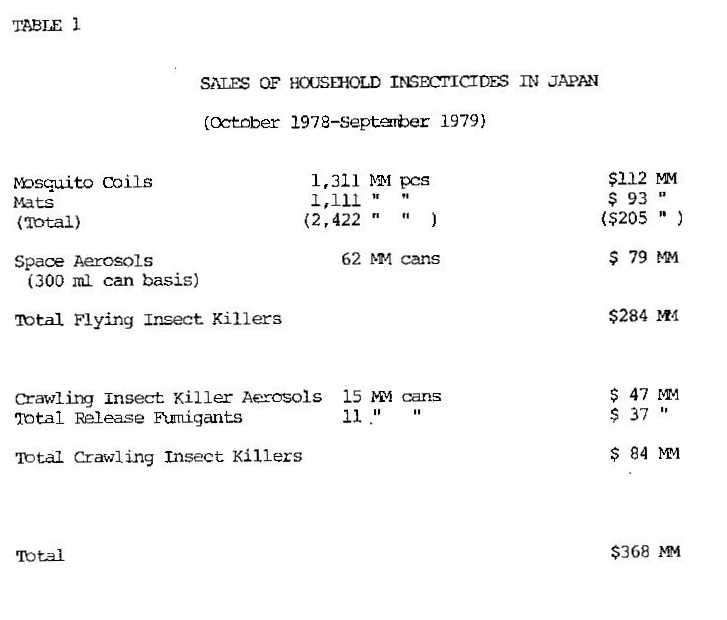
In 1979 flying insect killers accounted for 2.4 billion pieces of coils and mats and 62 million cans of space aerosols (on a 300 ml per can basis). The population of Japan is 116 million, so the annual consumption of flying insect killers per capita totals 21 pieces of coils and/or mats and 0.5 cans of space aerosol. As I explained earlier, a piece of coil or mat lasts 6-8 hours and in Japan coils and mats are used only during the summer, for 60-70 days. Taking this into consideration, this consumption is very large. In addition, crawling insect killers accounted for 15 million cans of aerosols and 11 million pieces of total release fumigants. Almost all of these products contain synthetic pyrethroids as the active ingredients.
In 1965 1 million pieces of coils and mats, 27 million cans of space aerosols, and a few million cans of residual aerosols were sold. So in 15 years the sales quantities have increased 2.4 times for coils and mats and more than 2 times for aerosols. In the case of the crawling insect killers, the increase is tremendous. Although the population of cockroaches has increased during this period, mosquitoes and flies have decreased to a great extent because sanitary conditions have been improved significantly. In addition, the improvement of housing conditions such as high-storied apartments, aluminum sash windows, and air conditioning facilities have made insect access much more difficult. In spite of these facts, sales of household insecticides have been increased.
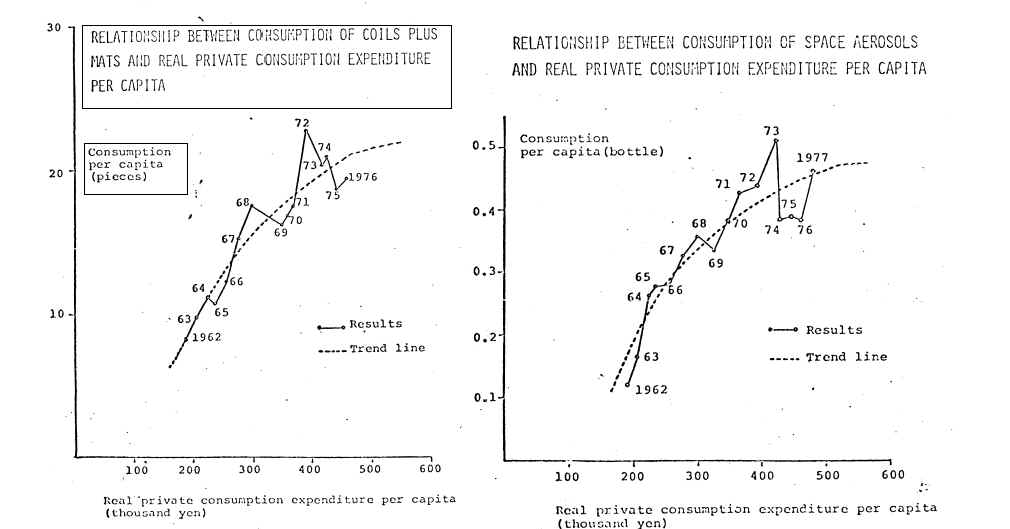
In analyzing statistics, we can find an interesting fact---consumption of household insecticides does not depend on numbers of insects but on population and consumption expenditures per capita as shown in pictures 1 & 2. The increase of consumption expenditures per capita along with the growth of the Japanese economy attributes for the increased sales.